
Chemical
Safety
Safe chemical storage and handling induction for everyone who uses cleaning chemicals on site.
- 01Energy forms for optimal cleaning
- 028 steps for the ideal cleaning schedule
- 03pH chemistry scale ladder
- 04What is a product label?
- 05What does a PDS look like?
- 06What does an SDS look like, and where do you find it?
- 07Ways chemicals could enter the body
- 08Chemical safety first aid
- 09Accidents and spills
- 10GHS pictograms
- 11Storage and manual handling procedures
- 12Quick quiz
Your details
These go on your completion certificate and the training record, so please use your full name as it appears on your roster.
Objective
This training module will assist in developing a greater understanding of the safe use of chemicals.
It will also provide an understanding that it is everyone's responsibility to practice workplace safety, ensuring the well-being of ourselves and others.
Work through the four parts in order, then answer the eight quiz questions. You need 7 out of 8 to pass. If you don't pass first go, you can retake the quiz.
How cleaning works
Energy forms, the eight-step schedule, and where products sit on the pH scale.
Energy forms
Effective cleaning combines three forms of energy. Get the balance right and you clean better at a lower cost.
Mechanical
Disrupts dirt and assists with breaking down soils.
Thermal
Assists by dissolving soils.
Chemical
Additive to assist with the removal of "water-insoluble" soils.
8 steps to an ideal cleaning schedule
Use the following steps and questions to build your schedule.
Identify the surface
The product must remove the soil but must also be compatible to the surface.
Identify the soil / dirt
Necessary in order to select the optimum product.
Which product?
You must have a basic knowledge of the product properties.
At what concentration?
For the best results at the lowest cost.
Which equipment?
How can the mechanical action be best applied?
At what temperature?
Heat may be essential to achieve the desired level of cleaning and hygiene.
What frequency?
Dependent upon the nature of the task and soil levels.
For how long?
The result will depend on the total energy supplied.
pH chemistry scale ladder
Products at either end of the scale are the most hazardous. Neutral products sit in the middle.
What each type does
Acids
- Used to remove mineral soiling, known as scaling.
- Acids will also attack rust and lime staining.
- They will not remove or dissolve fats, greases or oils.
Neutrals
- Used to assist acids and alkalis and can have some effect on soiling itself.
- Good detergents will encapsulate soil and carry it to waste.
- Poor detergents release soil back onto the surface.
Alkali
- Used to dissolve fats, grease and organic soiling.
Know before you use
Labels, Product Data Sheets, Safety Data Sheets and GHS pictograms.
Labels
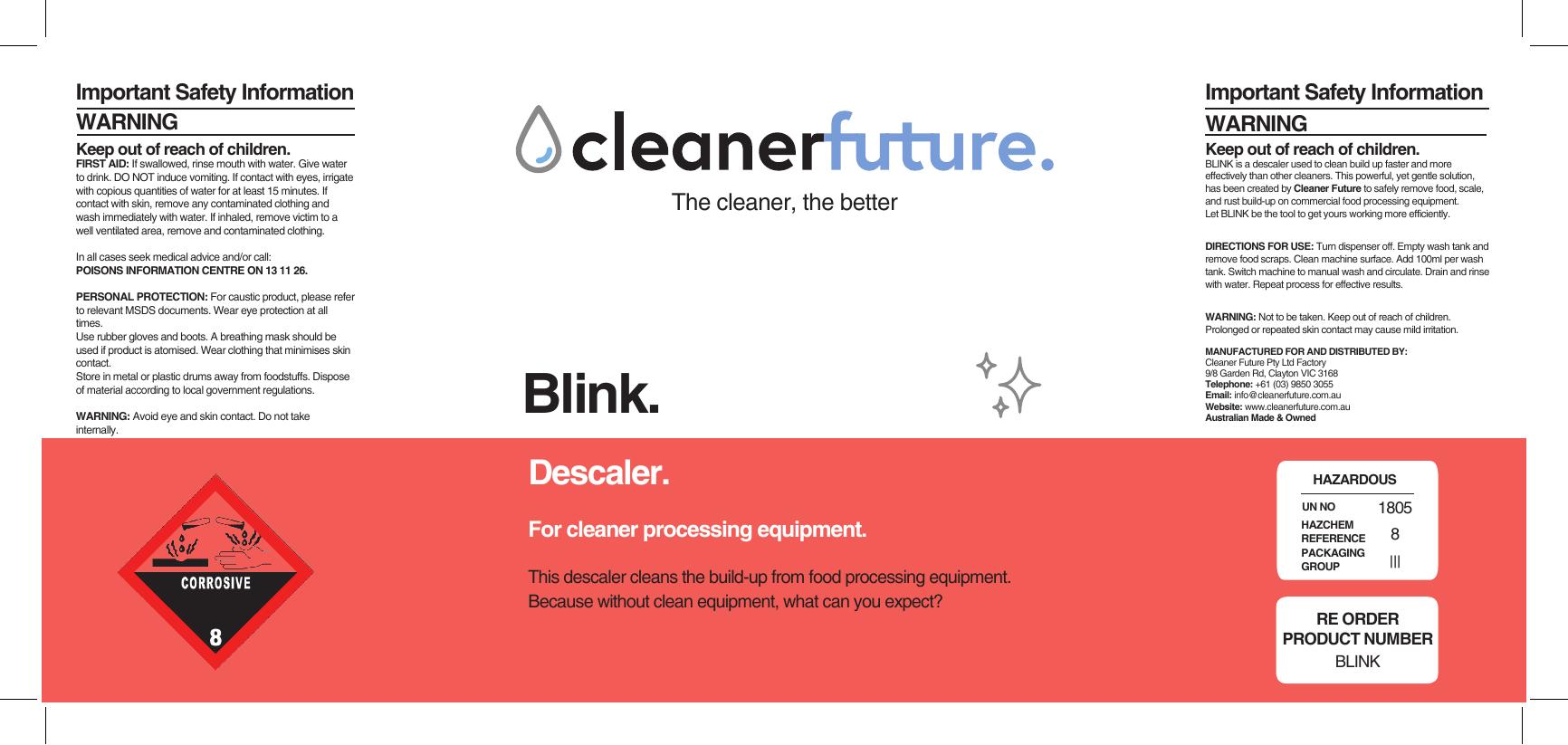
The product label is the best place to find information about cleaning chemicals.
- Product description
- Directions for use
- First aid information
- Safety directions
- Phone numbers
Product Data Sheet
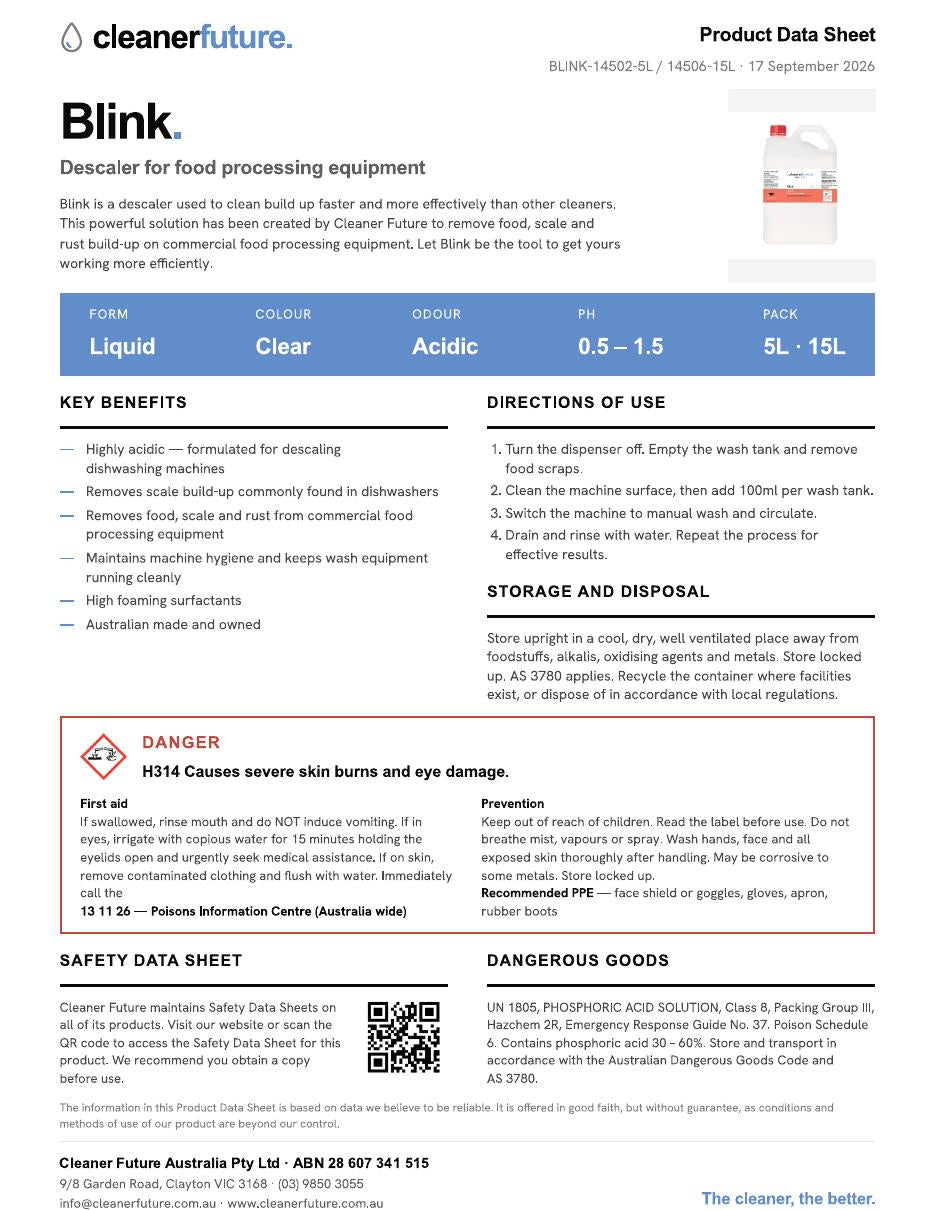
A Product Data Sheet (PDS) tells you what the product is for and how to use it properly.
Product name
Product description
Dilution & directions for use
Benefits
PPE
Safety Data Sheet
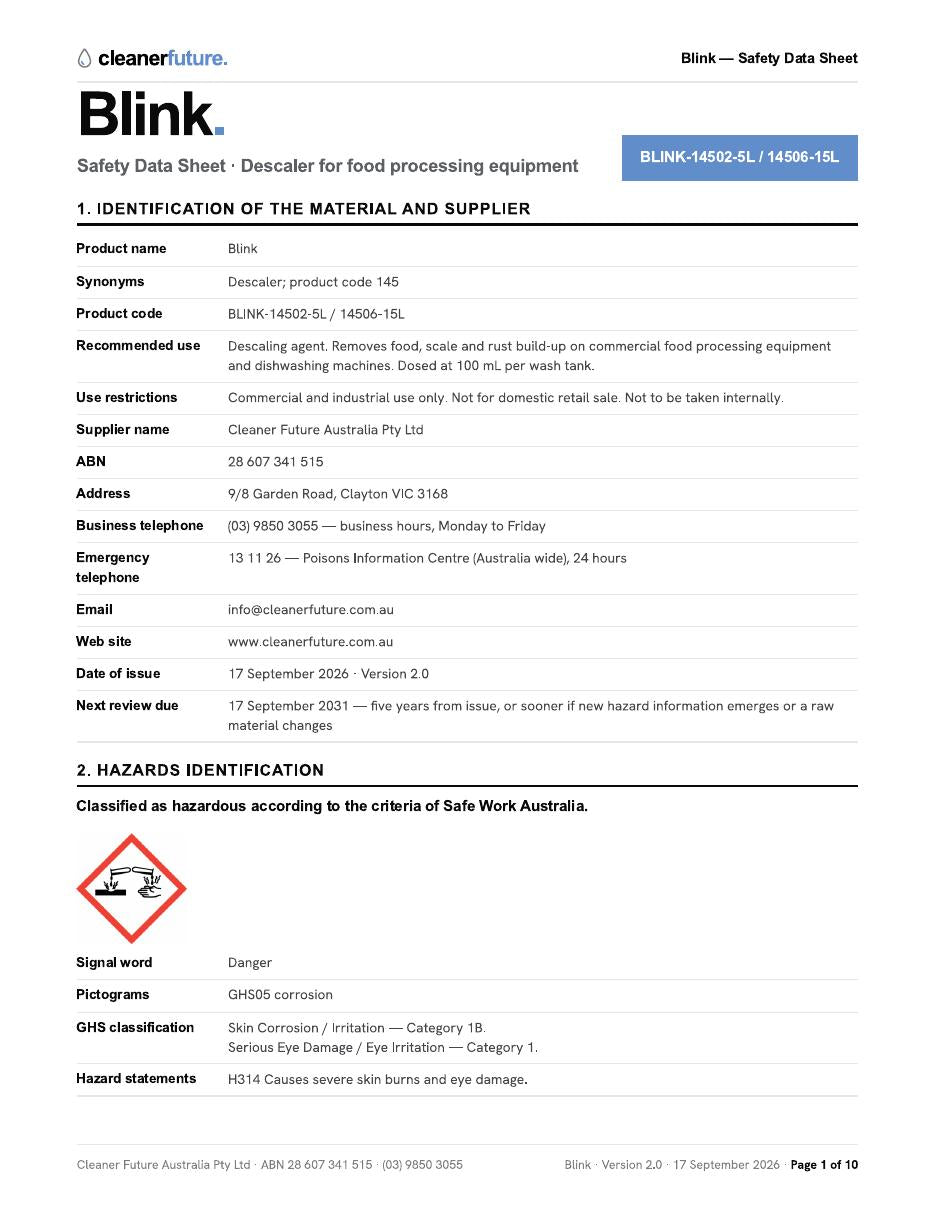
A Safety Data Sheet (SDS) contains additional information that you need to familiarise yourself with before using a product.
An SDS has more detail than a label, with information on:
- Product identification.
- The ingredients and properties of the product.
- Known potential health and physical hazards.
- First aid and emergency actions.
- Precautions you need to take when handling the product.
- Proper storage, clean up and disposal.
Every Cleaner Future product has an SDS. Scan the QR code on the Product Data Sheet, or ask your People Leader where the site's SDS folder is kept.
SDS: a closer look Sections 1 to 8
Identification of the material and supplier
Product name, its uses, supplier contact details and emergency contact numbers.
Hazards identification
Warning information and hazardous statements, including risk and safety phrases.
Composition / information on ingredients
Information on any ingredients which are classified as hazardous.
First aid measures
The need and urgency for medical attention and what to do for eye/skin contact, inhalation and ingestion.
Fire fighting measures
Information for use in an emergency situation, including any special protection equipment for fire fighters.
Accidental release measures
Appropriate responses to spills including personal precautions, environmental precautions and methods to clean up spills.
Handling and storage
Safe handling and storage practices, including compatibility, to minimise potential hazards.
Exposure controls / personal protection
Measures to minimise risk, occupational exposure limits and recommended PPE.
SDS: a closer look Sections 9 to 16
Physical and chemical properties
Physical state and colour of the product, along with other properties such as boiling points and pH.
Stability and reactivity
Under what conditions the product is stable, what conditions to avoid, and any hazardous reactions that could be expected.
Toxicological information
Potential acute and chronic health effects and their symptoms.
Ecological information
Any specific ecological statements about environmental hazards.
Disposal considerations
Recommended methods of disposal of the product or any by-products, including cleaning solution, unused material and "empty containers".
Transport information
Codes used in preparing the product for shipping or transportation.
Regulatory information
Regulatory status of the product under relevant health, safety and environmental legislation.
Other information
The date of the previous SDS which this one replaces, what changed, references and disclaimers.
GHS pictograms
Hazardous substance legislation requires that all hazardous substances are labelled correctly, that is in accordance with the labelling code.
"The GHS is an international system of classifying and communicating chemical hazards. It is used on chemical labels and safety data sheets."
 GHS01 · Exploding bomb
Explosives, organic peroxides, or self-reactive substances with high blast or fire risks.
 GHS02 · Flame
Flammable liquids, gases, solids, and aerosols, plus self-heating items.
 GHS03 · Flame over circle
Oxidizers that can cause or intensify fires.
 GHS04 · Gas cylinder
Compressed, liquefied, or dissolved gases under pressure.
 GHS05 · Corrosion
Materials causing severe skin burns, eye damage, or corrosion to metals.
 GHS06 · Skull and crossbones
Fatal or toxic acute effects from small exposure amounts.
 GHS07 · Exclamation mark
Lower-level irritants, skin sensitizers, or harmful health effects.
 GHS08 · Health hazard
Chronic health risks like carcinogens, respiratory sensitisers, or reproductive toxicity.
 GHS09 · Environment
Dangerous and toxic hazards to aquatic life and ecosystems.
Working safely
Mixing, exposure, first aid, PPE, spills and reporting.
Never mix
Mixing chemicals can result in a reaction causing a toxic gas or explosion. It may cause an accident and lead to serious injury.
Eliminating splash
Add chemical to water.
Fill the container with water first, then add the measured amount of product.
Add water to chemical.
Adding water to chemicals may cause a reaction that could splash into the eyes or onto the skin.
Chemical exposure
Different ways you can be exposed to chemicals:
Absorption
Through skin and eyes
Inhalation
Through nose or mouth
Ingestion
Through mouth
First aid instructions
If swallowed, DO NOT induce vomiting. Give plenty of water to drink. Seek urgent medical assistance.
If material splashed into eyes, flush with plenty of water for at least 15 minutes, ensuring eye lids are held open. Immediately transport to hospital or doctor.
If material is splashed onto the skin, remove any contaminated clothing and wash the skin thoroughly with water and soap. Immediately transport to hospital or doctor.
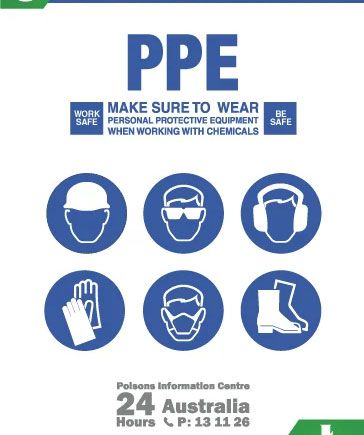
Personal protective equipment
- Wear the correct PPE for the product.
- Ensure correct use of PPE.
- You must comply with PPE use, as it is supplied for your safety.
Staff can face fines under OHS legislation for non-compliance.
Accidents and spills
Report
Always report chemical accidents and spills to your supervisor. Your safety and that of your workmates and guests may be affected.
Spills
If a cleaning chemical is spilled, you need to isolate the area and report to your People Leader as soon as possible to reduce exposure to others, slip injuries and the chance of the chemical contaminating drains or waterways.
Emergency contact numbers
Life-threatening emergencies / spills with injury. Call 000 for fire, police, or ambulance.
Poisoning or exposure advice. Call 13 11 26 anywhere in Australia for 24/7 expert advice. Do not wait for symptoms to appear.
Environmental / large chemical spills. Contact local emergency services via 000 if the spill is volatile, toxic, or posing an immediate explosion or fire risk.
Storage and manual handling
When working with cleaning products or any chemicals, there are some basic safety steps we all must take.
- Knowing what you are handling.
- Reading the label and SDS.
- Knowing what to do in an emergency.
- Wearing the appropriate PPE as shown on the SDS.
- Washing your hands after using cleaning products.
- Adding product to water (NOT water to product) to avoid concentrated splashes.
- Storing, dispensing and disposing of chemicals safely and correctly.
- Using chemicals from unlabelled containers.
- Storing chemicals in unlabelled containers.
- Storing chemicals at high temperatures (refer to the SDS).
- Mixing chemicals.
- Inhaling or ingesting chemicals. For example, do not sniff at chemicals to try to determine what it is. If it isn't labelled, do not use it.
- Allowing contact with skin or eyes.
Dispensing & hygiene
Labelling, controlled dosing, proportioning and hand hygiene.
Decanting & labelling
When decanting into smaller containers please use only Cleaner Future-supplied labels.
Cleaner Future Dispenser Bottle labels comply with appropriate labelling codes.
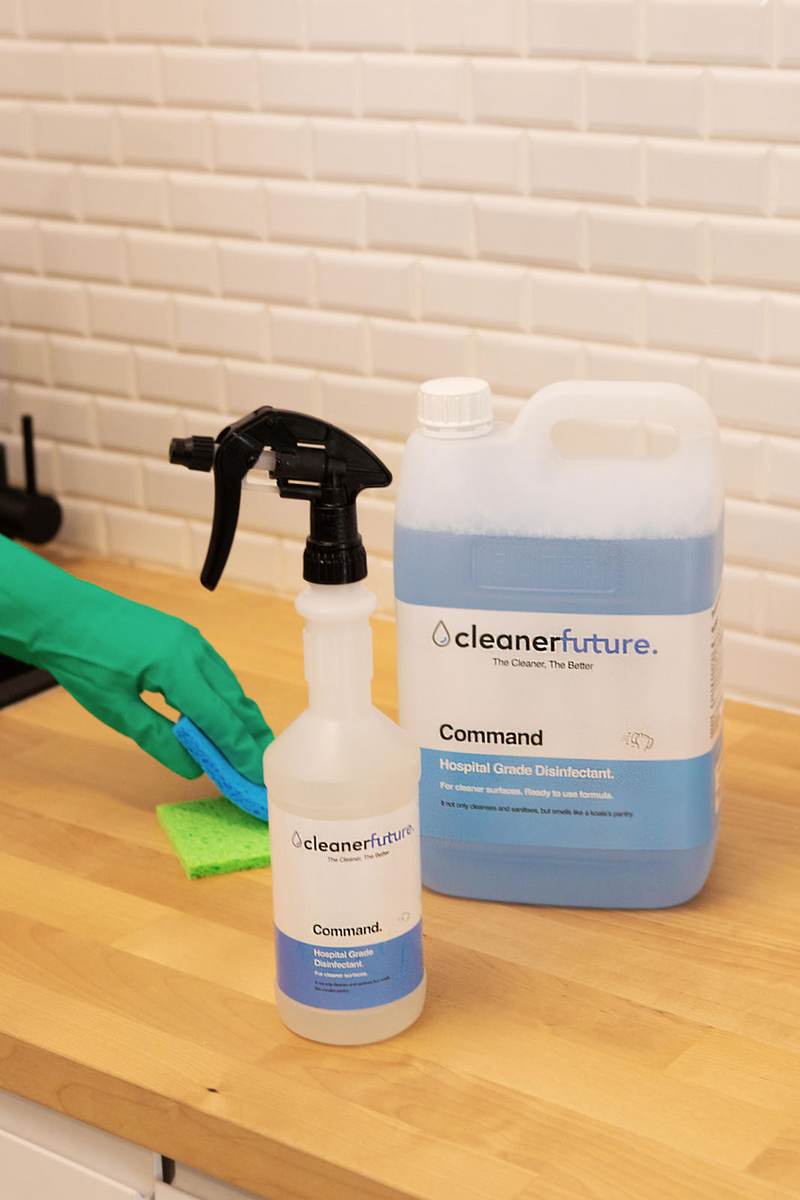
Dispensing equipment
These are some of the dispensing systems you may see onsite. Equipment varies between sites, so check with your People Leader which units are installed at your location and how they are set up.
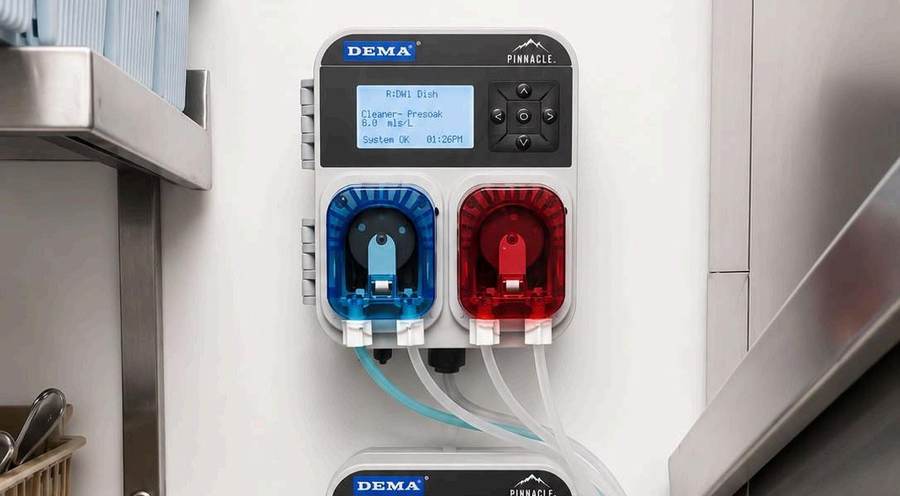
Precision dosing units
Wall-mounted dosing units for commercial dishwashers, metering detergent and rinse aid at a set rate per litre with the dose and system status shown on the display.
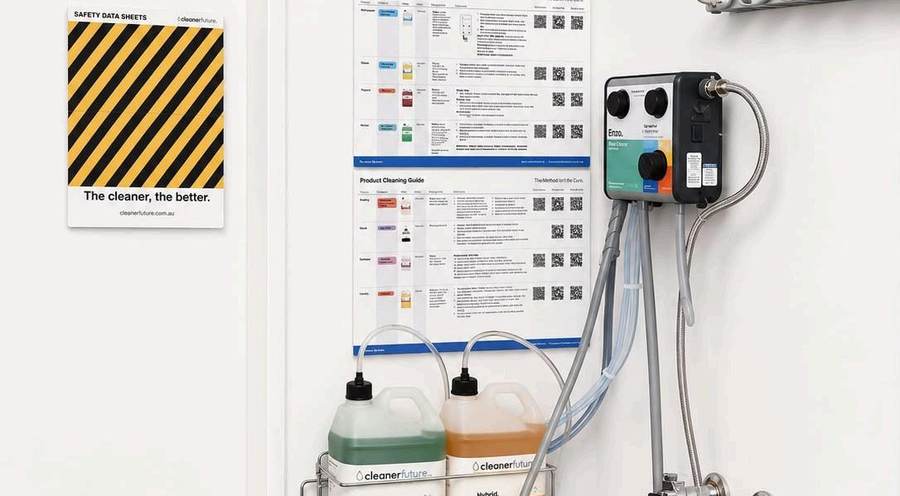
Auto dosing station
A central station that draws from bulk product and dispenses at the correct dilution into buckets and bottles, with each outlet dedicated to a single product.
Hand hygiene
Always wet your hands before applying soap. Soap on dry hands may irritate.
Wash between the fingers, fingernails and into the palm of your hands.
Rinse thoroughly with clean running water.
After washing, always dry your hands completely.
You've finished all four parts. Next is the quick quiz: eight questions, one answer each, and you need 7 of 8 to pass.
Quick quiz
Eight questions. Choose one answer for each, then check it before moving on.
Your result
Sign off and get your certificate
This certifies that
has completed the
Module 1 · Chemical Safety, Cleaning & Sanitising Training Program
Your completion record goes to Cleaner Future automatically and is kept on file for your site. Printing gives you the certificate as a PDF to keep or hand to your People Leader for the site training file.
Thank you for completing the training for the safe use of chemicals. The cleaner, the better.